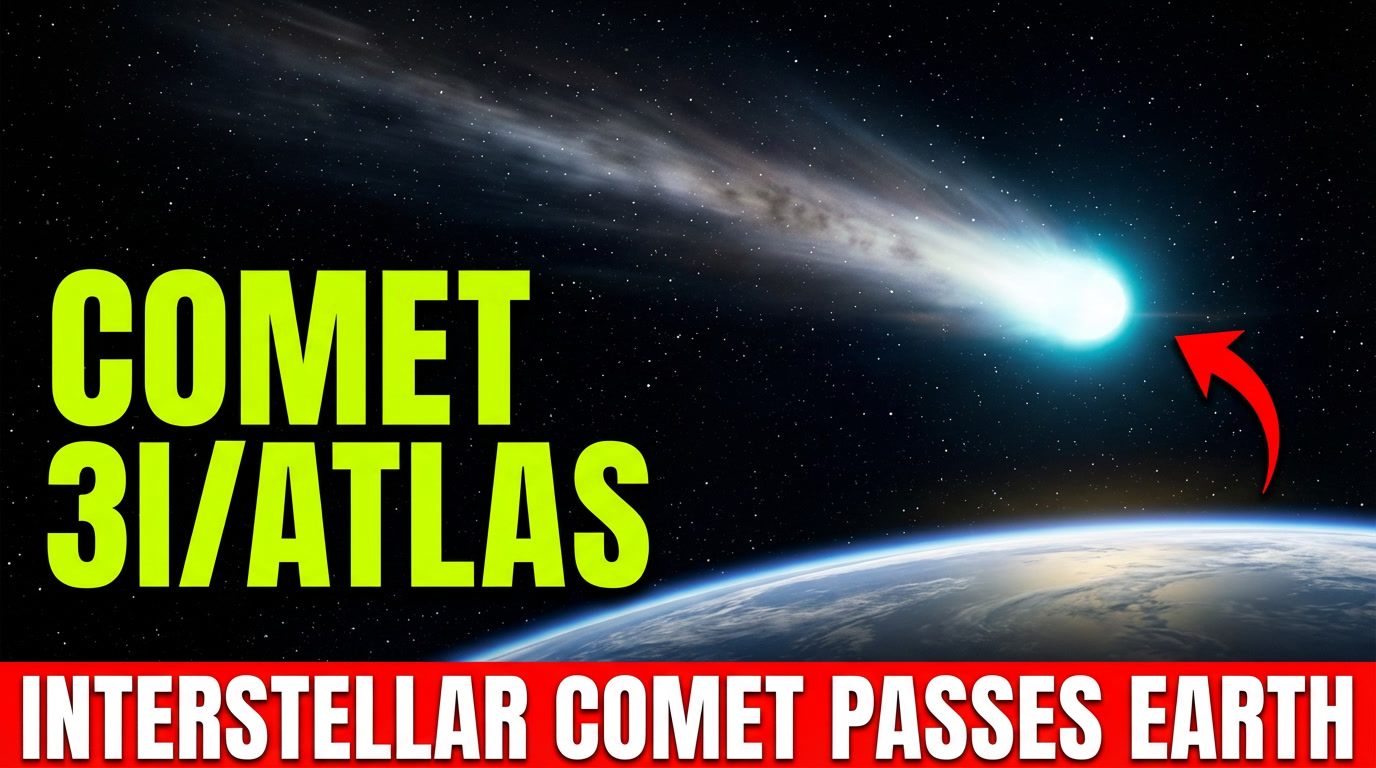
The night sky just got a little more interesting. On December 19, 2025, Comet 3I/ATLAS made its historic close pass by Earth—an event that had astronomers and sky-watchers worldwide buzzing with excitement. Though “close” in cosmic terms means a staggering 270 million kilometers (168 million miles) away, this was still the comet’s nearest approach to our planet, offering an extraordinary window for study and observation.
A Rare Visitor from Beyond the Solar System
Comet 3I/ATLAS isn’t just any space rock—it’s an interstellar visitor, meaning it originated outside our solar system. The “3I” in its name actually stands for the third interstellar object ever detected, following ‘Oumuamua (1I/2017 U1) and Comet Borisov (2I/2019 Q4). That makes this encounter a big deal for scientists eager to understand what’s floating between the stars.

Discovered earlier in 2025 through the Asteroid Terrestrial-impact Last Alert System (ATLAS) in Hawaii, the comet immediately stood out for its unusual trajectory and chemical makeup. Its hyperbolic orbit—meaning it’s not bound by the Sun’s gravity—confirms that it’s passing through our system only once before disappearing forever into deep space.
The December 19 Flyby: A Perfect Window for Observation
At its closest approach on December 19, Comet 3I/ATLAS provided astronomers with an ideal opportunity to observe an interstellar object in real time. With an apparent magnitude hovering around +10, it wasn’t visible to the naked eye, but telescopes across observatories—from Chile’s European Southern Observatory to NASA’s Infrared Telescope Facility—tracked it intensely.
| Event | Details |
|---|---|
| Closest approach date | December 19, 2025 |
| Closest distance to Earth | ~270 million km (168 million miles) |
| Origin | Interstellar (outside the solar system) |
| Discovering system | ATLAS (Hawaii) |
| Apparent magnitude | ~+10 |
| Visibility | Telescope only |
| Trajectory | Hyperbolic, outbound after December 2025 |
Scientists expect to use spectroscopic data gathered during the flyby to analyze the comet’s chemical composition, searching for organic molecules, frozen gases, or dust characteristics that differ from comets born in our own solar neighborhood.
What Makes 3I/ATLAS Unique

Most comets in our solar system follow elongated elliptical orbits, looping around the Sun every few decades or centuries. Interstellar comets like 3I/ATLAS, however, move on one-time, hyperbolic paths, cutting through the solar system before speeding back into interstellar space—never to return.
Early observations suggest 3I/ATLAS has a dense coma (gas cloud) and an unusually blue-tinged tail, indicating a mix of exotic ices and materials not commonly seen in local comets. The tail’s composition might hold clues about the environment of the distant star system it came from—potentially shedding light on the conditions that formed other planetary systems.
NASA’s Jet Propulsion Laboratory (JPL) and the European Space Agency (ESA) have both confirmed that the comet’s orbit is completely safe—no collision risk whatsoever. In fact, “close” in astronomical terms still means nearly twice the distance between Earth and the Sun.
How to Watch It: Online and in the Sky

While backyard stargazers couldn’t spot Comet 3I/ATLAS without high-grade equipment, observatories and astronomy organizations streamed its journey online. Several major science institutions—including NASA’s Eyes on the Solar System—hosted live tracking and simulations for space enthusiasts eager to witness this one-time event.
If you missed it live, telescope imaging archives and sky-mapping platforms will continue sharing updated visualizations over the next several months as 3I/ATLAS fades from view.
Why Scientists Are So Excited
Interstellar comets like 3I/ATLAS serve as cosmic messengers, carrying physical samples of matter from beyond our solar system. Studying them helps scientists:
- Compare chemical compositions between stellar systems.
- Understand how materials form and evolve in cold interstellar space.
- Gain insights into how our own solar system might look to distant observers.
By analyzing the comet’s spectral fingerprint, researchers can detect elements like carbon, nitrogen, and oxygen, as well as complex organic compounds. These results can later be compared with data from ‘Oumuamua and Borisov to build a clearer picture of how interstellar objects behave and what they’re made of.
What Happens Next
After the December 19 flyby, Comet 3I/ATLAS will continue its outbound journey, steadily dimming as it leaves the Sun’s gravitational sphere of influence. By early 2026, it will be far beyond the reach of most ground-based telescopes, becoming another faint traveler in interstellar space.
Still, data collected during this window will likely fuel years of research papers, helping scientists model the early stages of planet formation and interstellar material exchange.
FAQs
What is Comet 3I/ATLAS?
It’s the third confirmed interstellar comet ever detected, discovered by the ATLAS survey in 2025.
How close did it come to Earth?
Its nearest approach on December 19, 2025, was about 270 million kilometers (168 million miles) away.
Can I see it without a telescope?
No, the comet’s brightness (magnitude +10) requires professional telescopic equipment.
Is there any danger to Earth?
None at all. The comet’s trajectory keeps it safely distant from our planet.
Where can I track or watch it online?
NASA’s “Eyes on the Solar System” and the European Southern Observatory offered live visual tracking and later imagery.