It started with a click — a seemingly harmless one. But that single tap on a search ad led thousands of Americans straight into a sophisticated bank account takeover fraud that drained millions from personal and business accounts across the country.
Now, the U.S. Justice Department says it has shut down one of the core digital command centers behind the scam — seizing a web domain and database allegedly used by criminals to harvest and manage stolen financial data at scale.
A Fraud Built on Search Engine Ads

The takedown, announced Monday by the Department of Justice (DOJ), targeted the site web3adspanels.org, which investigators described as a “control panel” for cybercriminals. The domain was allegedly used to coordinate and manage a sprawling online fraud operation that weaponized search engine advertising to mimic legitimate banking links.
Here’s how it worked: criminals bought paid ads on major search platforms like Google and Bing, crafting them to appear identical to real links from major U.S. banks. Victims searching for their bank’s website would click these top-of-page ads, believing they were logging into their accounts as usual.
Instead, they were redirected to counterfeit websites — eerily convincing replicas of legitimate banking portals. The moment victims typed in their usernames and passwords, malicious code embedded in the fake sites captured their credentials in real time, investigators said.

Those stolen details were sent back to web3adspanels.org, where attackers organized and used them to break into real accounts and transfer funds — often within minutes.
Millions Lost, Millions More at Risk
According to court documents, the FBI has so far identified at least 19 victims, including two Georgia-based companies, with attempted losses nearing $28 million and confirmed thefts of about $14.6 million.
The seized website’s database reportedly stored thousands of stolen banking credentials, and investigators say the system was still active as recently as November 2025 — proof that the operation remained live well into the holiday season.

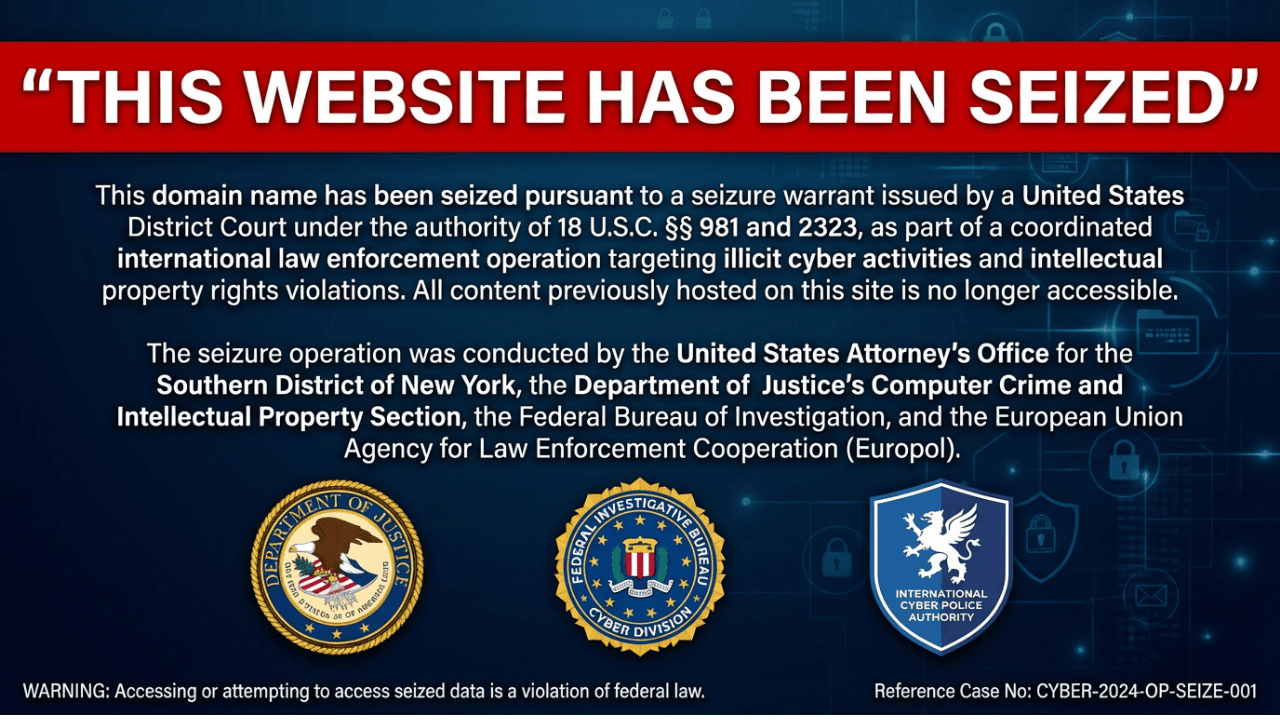
Visitors to the domain now see a bold federal seizure banner stating that the site has been taken offline by law enforcement. Cutting off access, officials said, was critical to disrupting the fraudsters’ infrastructure and preventing further attacks.
“This operation shows that we can and will dismantle the digital infrastructure that enables organized financial crime,” one federal prosecutor involved in the case said. “This wasn’t a small phishing ring — it was a professional enterprise built to exploit trust in online advertising.”
A Growing Threat: Search Engine Spoofing
While phishing emails have long been the hallmark of online scams, search engine spoofing represents a newer, more insidious tactic. It preys on user trust in mainstream search platforms — and it’s proving remarkably effective.
The FBI’s Internet Crime Complaint Center (IC3) reports that since January 2025, more than 5,100 complaints related to account takeover scams have been logged nationwide, with reported losses surpassing $262 million.
The agency warns that attackers increasingly use paid ads and SEO manipulation to position fake bank links at the very top of search results, where victims assume legitimacy. Once credentials are compromised, criminals can quickly execute unauthorized transfers, often layering transactions through crypto exchanges or money mules to obscure the trail.
For individuals and businesses, the takeaway is simple but urgent: never click on a bank link from a search engine ad. Instead, type the official web address directly into your browser or use your institution’s official app.
Inside the DOJ’s Cyber-Crime Crackdown
The web3adspanels.org seizure is part of a larger, coordinated push by U.S. authorities to disrupt digital infrastructure used in large-scale fraud schemes. Similar operations have targeted dark web marketplaces, ransomware payment portals, and crypto laundering networks.
Under federal warrant, agents from the FBI’s Atlanta Field Office and the U.S. Secret Service’s Cyber Fraud Task Force executed the domain seizure, supported by the DOJ’s Computer Crime and Intellectual Property Section (CCIPS).
A DOJ statement noted that the operation “neutralized a critical hub used to facilitate bank credential theft and money movement,” emphasizing that investigations into the individuals behind the scheme are still ongoing.
Publicly available court filings suggest that the system included automated credential testing tools, enabling criminals to validate stolen logins before launching transfer attempts — effectively industrializing bank fraud.
What Victims Can Do
Authorities are urging anyone who suspects their banking information may have been compromised to:
- Immediately contact their financial institution to freeze access and verify transactions.
- File a report with the FBI’s Internet Crime Complaint Center (IC3.gov).
- Update online banking credentials and enable multi-factor authentication wherever possible.
- Avoid interacting with “sponsored” search results when accessing sensitive websites.
Consumers can also visit the Federal Trade Commission’s (FTC) Identity Theft website for step-by-step recovery guidance.
A Familiar Pattern, A New Front
While the “web3adspanels” network is now offline, experts warn that copycat systems could emerge. The infrastructure was simple enough to replicate — but what made it dangerous was the trust users placed in the web platforms serving the fake ads.
“This isn’t about hacking in the technical sense,” said one cybersecurity analyst. “It’s social engineering at scale, using the credibility of search engines as bait.”
The broader challenge for regulators and tech companies will be preventing these fraudulent ads from slipping through in the first place. Google and Microsoft’s ad networks have both pledged stronger identity verification for financial advertisers, but the pace of enforcement has lagged behind the creativity of fraudsters.
For now, the domain seizure is a win — a symbolic and practical strike against a multimillion-dollar crime network. But as with most cyber cases, the battle doesn’t end with one takedown. It only sets the stage for the next one.
FAQs
What was web3adspanels.org used for?
It was allegedly a control panel that stored and managed stolen banking credentials used in online fraud schemes.
How did the attackers trick people?
They purchased fake bank ads on search engines like Google and Bing that redirected users to counterfeit websites.
How much money was stolen?
Roughly $14.6 million in confirmed losses and nearly $28 million in attempted thefts, according to the FBI.
What should I do if I think I was affected?
Immediately contact your bank, report the incident at ic3.gov, and change all online banking passwords.
Are the criminals behind the site arrested?
Investigations are ongoing; the DOJ has not yet disclosed individual charges or arrests.